Description
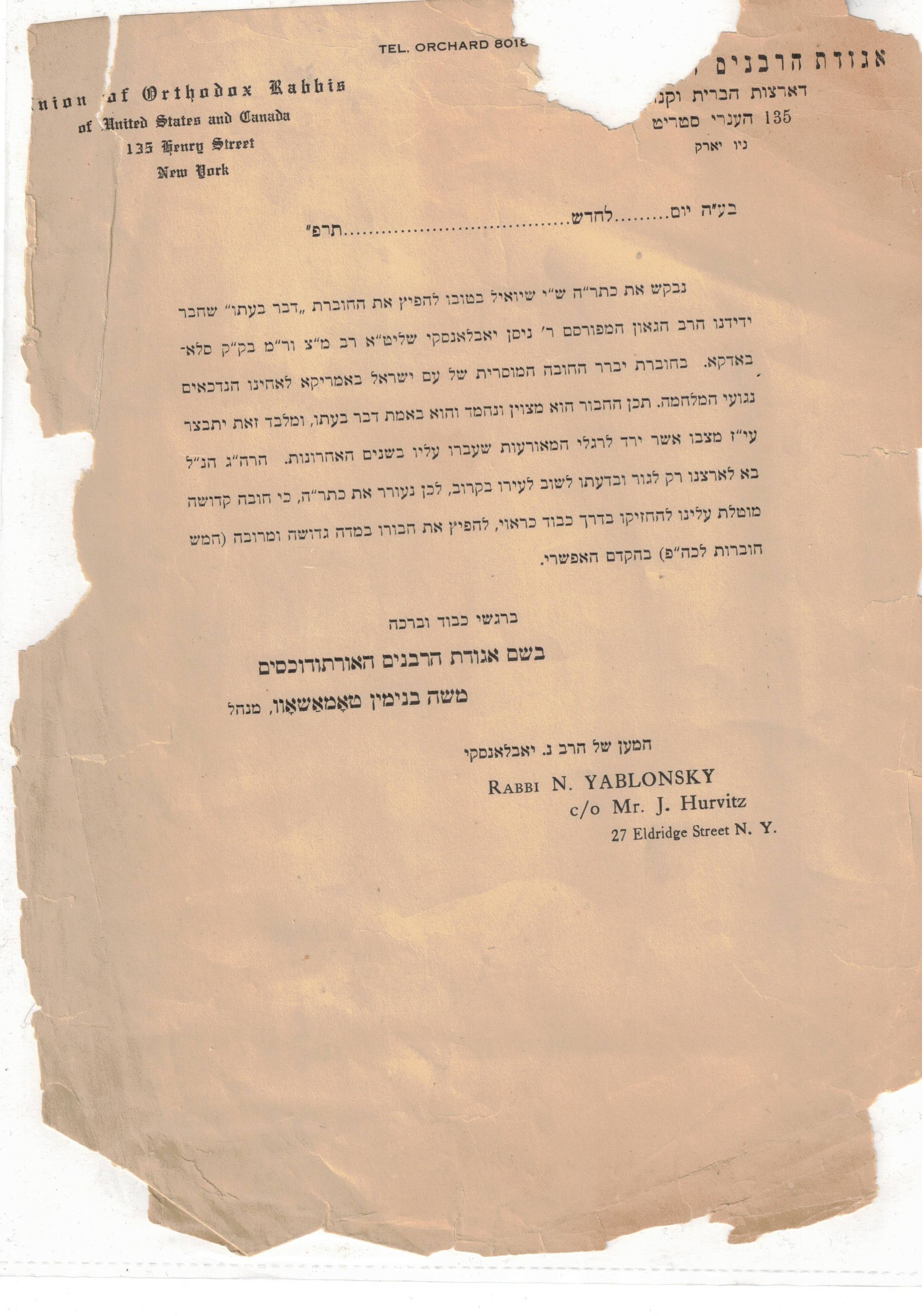
Issuing Body: The prestigious Union of Orthodox Rabbis of the United States and Canada (אגודת הרבנים דארצות הברית וקנדא), operating from their historic headquarters at 135 Henry Street on the Lower East Side of New York.
Signatory (Printed): Issued under the printed name of the Executive Director, Rabbi Moshe Benjamin Tomashoff (משה בנימין טאמאשאוו, 1879–1960), a famous Lithuanian-born scholar, author of Anshei Shem, and chief editor of the rabbinic journal Yagdil Torah.
Content & Context: This rare official circular appeal was printed during the 1920s (שנות התר"פ) to rally financial support for the brilliant refugee titan Rabbi Nissan Yablonsky (רבי ניסן יאבלונסקי, 1876–1928). Rabbi Yablonsky, the former renowned Rosh Yeshiva of Slotzk (and later the pioneering Rosh Yeshiva of Hebrew Theological College in Chicago), had newly arrived in America completely destitute after fleeing the harrowing aftermath of World War I and the Bolshevik revolution.
The Appeal: The Agudath HaRabbonim urges communities to purchase and distribute Rabbi Yablonsky’s newly printed ethical treatise, "Davar Be’Ito" (דבר בעתו), which addresses the moral obligations of American Jewry toward their suffering brethren in Europe ("החובה המוסרית של עם ישראל באמריקה לאחינו הנדכאים נגועי המלחמה"). The letter details his broken financial state due to the recent tragedies ("מצבו אשר ירד לרגלי המאורעות שעברו עליו בשנים האחרונות").
Notable Connection: This document provides raw, primary evidence of how the American rabbinate mobilized to rescue and restore the displaced intellectual elite of European Jewry following WWI. It prominently lists Rabbi Yablonsky’s temporary Lower East Side c/o address at 27 Eldridge Street, N.Y.
Condition report:
Status: Fair/Poor Antique Condition – As-Is Document.
Details: This is a fragile, text-complete printed circular sheet. The paper exhibits heavy, characteristically high-acid vintage toning, brittleness, and extensive fraying along the edges. Notable paper loss is present at the top margin (affecting parts of the printed letterhead) and along the side margins, though the central letter text, rabbinic names, and address blocks remain 100% complete and legible.